Los Medicos from FrontrunnerMedia on Vimeo.

COTA enhances the health and wellbeing of underserved women and children in developing countries through international collaboration.
Thursday, March 27, 2014
Our COTA Documentary, Los Medicos
Several years ago, Children of the Americas was fortunate to have a documentary team accompany us on a COTA medical team. Many of our supporters do not have an opportunity to accompany us on a trip to Guatemala. This film offers insight on what our week in Guatemala looks like.


Thursday, March 20, 2014
Thoughts From our Executive Director
As a
small non-profit in today’s world, Children of the Americas, Inc. (COTA) faces
a myriad of challenges. The organization
continually strives to meet those challenges and continue to provide quality
medical and surgical care to indigent women and children in Guatemala.
The biggest challenge facing COTA is
funding for our programs. Although we
rely heavily on donated equipment, supplies and volunteer support, there are
substantial costs that require financial support. These include transport of supplies to
Guatemala, medicines for the team clinic, and passport and visa costs for
children who travel to the U.S. from Guatemala for donated care. With so many non-profit organizations vying
for available donor funds, COTA finds it increasingly difficult to secure the
financial resources necessary to continue our mission.
Another challenge that COTA faces is
logistical support, both here in the U.S. and in Guatemala. In the U.S., COTA depends largely on
volunteers to coordinate supply donation and shipment. Although COTA is blessed with many wonderful
team members and partners, busy lives and other commitments sometimes get in
the way of volunteerism. Careful pre-planning
and advance scheduling are necessary to maximize the available resources that
the organization depends upon to succeed.
In Guatemala the challenge is even greater. Again, COTA is blessed with dedicated
partners, but the reality of life in Guatemala curtails volunteerism. More than 50% of the population lives in
abject poverty, and even those who are gainfully employed struggle to feed
their families on the low wages that are prevalent in that country. As a result, volunteerism necessarily takes a
“back seat” to the basics of survival.

Another hurdle facing COTA’s work in
Guatemala is the country’s financial infrastructure. Guatemala is very poor and their resources
are scarce. There are few resources to support health care for the indigent. When COTA arrives on site for the annual
team, the hospitals are unable to provide even the most rudimentary support,
and often look to COTA for assistance. Poorly
maintained buildings, broken equipment, and inadequate supplies are the norm,
and provide enormous challenges to the team on their annual trip. As a result, COTA operates very much as a
MASH unit, transporting its own equipment and supplies to the site to ensure
efficient quality care to the patients.
Despite the
challenges the organization faces, COTA is also blessed with a number of
opportunities to grow and improve our efforts to provide quality health care to
our patients. It is COTA’s mission to
take full advantage of these opportunities as we move forward into the future.

Each team to Guatemala provides COTA an
opportunity to form new partnerships with the areas and people we serve. We have returned to several locations in
Guatemala on more than one occasion. Each
return strengthens COTA’s relationships with the hospital, director, and staff,
which in turn facilitates a smooth transition for future teams. The local community is better able to
anticipate our needs, and we are more prepared to assist them with theirs. With missions to new locations, we are provided
an opportunity to broaden the areas and the people we serve.
In addition to
these partnerships, we also have the opportunity to expand the educational
aspect of our mission.

At every time
site, local physicians and health care providers are encouraged to work side by
side with our providers in order to provide teaching opportunities for all,
including recognition and treatment of disease, preventative health care, and
surgical techniques. The sharing of
educational wealth leads to better quality health care for the
women and children we help.
 Finally, and very
importantly, COTA gives its volunteers an opportunity to see life beyond the
U.S. borders. It allows them to
experience first-hand the vast contrast in the standard of living and access to
health care in developing countries. It
also shows them the rich and diverse cultures of the people of Guatemala. It is COTA’s wish and aspiration that those
volunteers will bring back those lessons to the U.S., and that those lessons
will lead them to a better appreciation of diversity of culture as well as a
desire to continue and expand their altruistic work, both in the U.S. and
abroad.
Finally, and very
importantly, COTA gives its volunteers an opportunity to see life beyond the
U.S. borders. It allows them to
experience first-hand the vast contrast in the standard of living and access to
health care in developing countries. It
also shows them the rich and diverse cultures of the people of Guatemala. It is COTA’s wish and aspiration that those
volunteers will bring back those lessons to the U.S., and that those lessons
will lead them to a better appreciation of diversity of culture as well as a
desire to continue and expand their altruistic work, both in the U.S. and
abroad.Thursday, February 6, 2014
Effervescence
Solid infrastructure + passion = Collective Effervescence
(Meaning: gathering together for a common good creates feelings of well-being among volunteers).
 |
| Team members arriving in Guatemala City, January 2014 |
 | ||||
| While our interpreters translated for several thousand patients; |
 |
| We entertained waiting patients; |
 |
| Guatemalan women and children waited for donated care (1,600 of them); |
 |
| And 98 patients received donated surgery; 4285 prescriptions were donated, 183 dental patients were cared for and 9 patients received donated orthotics.   |
It was a week filled with good
people doing great work for the common good of patients they had no
prior relationship with and would most likely never see again.
Passion + Commitment + professionalism = COTA Volunteers
Monday, December 23, 2013
Merry Christmas from Children of the Americas
The nurses are packing their suitcases:

The supplies have been packed and shipped:

The team t-shirts have been printed and dispersed:

The patients are waiting:

Meanwhile, until we get here:

We wish you the happiest of holidays.

Tuesday, December 3, 2013
Dis-Ability or Cape-Ability?
December third was the International Day of People with Disability, a United Nations
sanctioned day that aims to promote an understanding of people with
disability and encourage support for their dignity, rights and
well-being.
We at Children of the Americas are very familiar with disabilities, both professionally and in our volunteer roles helping women and children in Guatemala. During our annual trips to Guatemala we see children with twisted limbs, or no limbs at all. Infants with cleft palates that open into dark recesses of inner mouths; women with club feet that have never been repaired, or machete wounds that have created lack of limb use. Most of what we care for in the way of disabled women and children would be hard for our readers to see photos of.
During our annual trips to Guatemala, Children of the Americas orthotics volunteers distribute dozens of donated pairs of crutches, countless wheelchairs and prosthetic limbs, orthotic shoes and braces until we have no more to give. It is never enough; the need is endless, not only in Guatemala but world wide.
A new COTA volunteer can easily feel overwhelmed with the pressing concerns of some of our patients. There are very few social services in Guatemala that provide for handicapped women and children. No handicapped ramps, accessible doorways, special bus seating or custom made vans. Schools are not equiped to care for children with special needs, and parents struggle with providing even basic care. The Americans with Disability Act does not apply to this Central American part of the Americas.
But something special happens when new volunteers to our organization get through their first few days in Guatemala. They stop seeing our patients as dis-abled, and instead realize just how en-abled they are, if only through their positive attitudes and determination to make the best of what they have. If our patients don't realize their limitations, how can we do anything but agree?
 |
| Club Feet |
.JPG) |
| Syndactaly of hands |
During our annual trips to Guatemala, Children of the Americas orthotics volunteers distribute dozens of donated pairs of crutches, countless wheelchairs and prosthetic limbs, orthotic shoes and braces until we have no more to give. It is never enough; the need is endless, not only in Guatemala but world wide.
 |
| Shelley, COTA Physical Therapy volunteer |
But something special happens when new volunteers to our organization get through their first few days in Guatemala. They stop seeing our patients as dis-abled, and instead realize just how en-abled they are, if only through their positive attitudes and determination to make the best of what they have. If our patients don't realize their limitations, how can we do anything but agree?
 |
| Brothers after donated club foot repairs |
Thursday, October 31, 2013
The COTA Stork
Baby boomers remember the classic story about a stork, and its amazing ability to deliver infants to households wishing to expand their numbers. This large mythical bird had the strength to carry a full-term infant in its beak no less, flying endless miles to safely deposit a healthy and smiling infant into caring maternal and arms.
We are all wiser now about how babies make their way into the world, but you may not realize how complicated it is when the "COTA stork" network gets involved in bringing a sick baby to the United States for donated surgery. Here is baby B's story.
Born with a closed rectum, B. had a rare and complicated birth defect that required an emergency colostomy. While this surgery saved her life, the surgical intervention needed to allow her to pass stool correctly was not available in Guatemala. Her parents did the best they could to manage her bowel issues. Without running water, access to further medical care or colostomy bags, maintaining B's health care needs was a challenge that they were unable to meet. The parents were concerned about the future of their daughter, since the current surgical site was becoming too narrow for stool to pass through, the skin was breaking down around the surgery site and they were finding it more difficult to manage hygiene problems without colostomy bags.
Fate put three COTA volunteer nurses in B's village in September of 2012. Word that the American nurses were visiting the mountain traveled up a long path to Baby B's parents, and they quickly brought her down. Her abdomen was wrapped in rags to contain her stool, but the baby was well loved and cared for. On that rainy, cool day in the Guatemalan mountains, B's parents made the decision to trust Children of the Americas to network donated care in the U.S. for their baby.
If only it were that easy. Here is what had to fall into place for the "COTA stork" to start travel.
1. Foster parents willing to host this baby for 6-12 months had to be found. Bev and Warren Brandwine, long term COTA volunteers from New Jersey, quickly stepped forward. Before feeling 100% comfortable sending her baby to the U.S., baby B's mom wanted to meet Bev and Warren, which she did in January of this year. The baby cried, mom smiled. All was good.
2. A pediatric surgeon who specialized in this complex surgical repair had to be found, he had to agree to do the surgery free of charge and he had to secure paperwork from his office stating he would do so.
3. Repeat # 2 for a hospital qualified to care for the baby post-op per gratis. This took many months, since the hospital had valid concerns about the severity of the case and what was involved.
4. Medical exams and studies had to be obtained in Guatemala, showing barium studies of the baby's lower anatomy, to ensure that her repair was possible. Rosemary had to wire money to the person in Guatemala who was responsible (thank you Roland!) for getting the family to the testing site so that they could afford to travel, and have an interpreter. The tests then had to make their way to New Jersey for review.
5. The volunteer surgeon wanted to meet baby B in person, to examine her himself to assure he could repair her properly. In order to facilitate the meeting of the baby and surgeon, Bev and Warren and the surgeon flew to Guatemala City, where the surgeon examined the baby. Traveling back and forth to her village took the family several days and once again required a translator and escort.
6. Baby B had to travel with her family to the capital twice again to obtain the passport and visa, after lengthy paperwork done by our executive director, Rosemary Vance. The embassy in Guatemala City required an interview process, which overwhelmed Baby B.'s mother, but she knew this was a unique opportunity for her baby.
7. After all of the paperwork was complete, Bev and Warren prepared the house for a new foster toddler, and Bev flew off to Guatemala to escort baby B. to New Jersey. Son Cory provided a free airline ticket!
8. Sending your toddler to a foreign country to live with strangers is something most mothers can't fathom. Baby B's mother needed lots of support. As in a dozen relatives showing up at the hotel to say goodbye. Chaos reigned. Needless to say, neither Bev nor Baby B got much sleep in the hotel room that night before flying out of Guatemala.
9. Once in New Jersey, fate (a plugged colostomy site) necessitated that surgery be done sooner than had been planned. Stage one surgical repair was scheduled and went very well.
10. Soon after surgery, Bev and Baby B ended up in the ER again, this time for a skin and stoma infection caused by antibiotics. Long days in New Jersey, but overall good as both Baby B. and Mama B. grew into this new relationship.
We are all wiser now about how babies make their way into the world, but you may not realize how complicated it is when the "COTA stork" network gets involved in bringing a sick baby to the United States for donated surgery. Here is baby B's story.
 |
| Surgery site being examined by COTA nurse Barb, 9/12 |
Fate put three COTA volunteer nurses in B's village in September of 2012. Word that the American nurses were visiting the mountain traveled up a long path to Baby B's parents, and they quickly brought her down. Her abdomen was wrapped in rags to contain her stool, but the baby was well loved and cared for. On that rainy, cool day in the Guatemalan mountains, B's parents made the decision to trust Children of the Americas to network donated care in the U.S. for their baby.
If only it were that easy. Here is what had to fall into place for the "COTA stork" to start travel.
1. Foster parents willing to host this baby for 6-12 months had to be found. Bev and Warren Brandwine, long term COTA volunteers from New Jersey, quickly stepped forward. Before feeling 100% comfortable sending her baby to the U.S., baby B's mom wanted to meet Bev and Warren, which she did in January of this year. The baby cried, mom smiled. All was good.
 |
| Mama and baby meet foster parents, 1/13 |
2. A pediatric surgeon who specialized in this complex surgical repair had to be found, he had to agree to do the surgery free of charge and he had to secure paperwork from his office stating he would do so.
3. Repeat # 2 for a hospital qualified to care for the baby post-op per gratis. This took many months, since the hospital had valid concerns about the severity of the case and what was involved.
4. Medical exams and studies had to be obtained in Guatemala, showing barium studies of the baby's lower anatomy, to ensure that her repair was possible. Rosemary had to wire money to the person in Guatemala who was responsible (thank you Roland!) for getting the family to the testing site so that they could afford to travel, and have an interpreter. The tests then had to make their way to New Jersey for review.
5. The volunteer surgeon wanted to meet baby B in person, to examine her himself to assure he could repair her properly. In order to facilitate the meeting of the baby and surgeon, Bev and Warren and the surgeon flew to Guatemala City, where the surgeon examined the baby. Traveling back and forth to her village took the family several days and once again required a translator and escort.
6. Baby B had to travel with her family to the capital twice again to obtain the passport and visa, after lengthy paperwork done by our executive director, Rosemary Vance. The embassy in Guatemala City required an interview process, which overwhelmed Baby B.'s mother, but she knew this was a unique opportunity for her baby.
7. After all of the paperwork was complete, Bev and Warren prepared the house for a new foster toddler, and Bev flew off to Guatemala to escort baby B. to New Jersey. Son Cory provided a free airline ticket!
 |
| Post-op with mama Bev |
 |
| Baby B, 10/13 in N.J. |
10. Soon after surgery, Bev and Baby B ended up in the ER again, this time for a skin and stoma infection caused by antibiotics. Long days in New Jersey, but overall good as both Baby B. and Mama B. grew into this new relationship.
Here is the end result....a toddler, still facing another surgery, but on her way to a new life free of a colostomy, social stigmas and poor hygiene.
It took a year of paperwork, worry, planning and a flock of "COTA storks" but it was worth every flap of the wings.
Monday, September 30, 2013
Top Ten Questions (Children of the Americas style)
David Letterman is known for his comedic Top Ten Questions that he answers during his evening program. While his questions and answers are funny, they also ring of truth, which is the hallmark of good comedy.
Those of us on the Children of the Americas board have our own list of "Top Ten" that we have been asked frequently over the years. We thought this would be a good venue for telling you our answers.
Who started Children of the Americas?
Answer: COTA was started in the early 1980's by Judy Schwank in Bowling Green, KY. Judy saw the incredible humanitarian need in Guatemala during a natural disaster that occurred there, and founded COTA as a result. She has since resigned from our program.
Question # 2:
How do you find your volunteers?
 |
| COTA Pharmacy Volunteers |
Question # 3;
Where do most of your volunteers live?
Answer: Everywhere. From upstate New York to Seattle, Washington and everywhere in between. We also have many great friends in Guatemala who have been associated with our program for years, and they help us with logistical support and translating during our team week. With over 100 volunteers, we are the largest medical team that travels to Guatemala.
Question #4:
Where in Guatemala do you work?
Answer: Wherever the need is greatest, the Guatemalan hospital director can host us and the town can accommodate us. We alternate between working in coastal communities as well as in the mountains, with our goal being to reach the women and children who have no other access to surgical/medical care. Think of COTA as a mobile mash unit, and you will understand all that is involved in making a team happen. The logistics of getting a surgical/medical/dental/pharmaceutical and prosthetic team up and running for the week we are there in January takes many months of work before our volunteers even depart their hometowns in the states to join us.
 |
| Cleft patient, Team 2011 |
Question # 5:
How does Children of the Americas fund the work that you do?
Answer: Tenacity.
A few of our board members write grants. Some of them speak at churches, Rotary groups and private events, or even write personal checks. In this economic climate, it is difficult.
Question # 6:
How many paid staff members do you have?
Answer: None. We are an all-volunteer board and organization.
Question # 7:
Who pays for your volunteers expenses to travel with your teams?
Answer: The volunteers pay their own expenses, take personal vacation time, and bring items to donate to our patients. As we said, we have great volunteers!
Question # 8:
Where is the Children of the Americas office?
Answer: There isn't one!
Our Executive Director and President run COTA from their homes. This allows our organization to have very little overhead. Our operating budget runs around $50,000 per year, which allows us to donate around 130-140 surgeries, see several thousand clinic patients, take care of over 300 dental patients and provide free pharmaceuticals to our patients, as well as providing free prosthetics. If we had a physical office, our donated dollars would not go as far as they do.
Question # 9:
I understand that your organization only works in Guatemala. Why is that?

 Answer: When COTA was first founded, Guatemala was the adopted country of the person who started our organization. After a few years of traveling to this Central American country, our infrastructure was in place to allow us to do our work there. But the real reason is that we love the people and country.
Question # 10:
Children of the Americas sounds amazing, but I still don't "get" why your volunteers and donors like it so much?
Answer: COTA volunteers share a passion for making a significant humanitarian difference in the world. COTA offers us a wonderful venue to do this.
Want to know more? Here is our website:
http://www.childrenoftheamericas.org/
Saturday, July 27, 2013
COTA + Caring = Diplomacy

We would like to think that when a father meets us at the Guatemalan airport to receive his baby back following donated surgery in the United States,
 |
| Greeting his baby after a visit to the U.S. for donated cleft surgery |
When the patients we see in Guatemala observe our caring and competent volunteers offering free medical, dental, orthotics and surgical care, they feel the concern we have for those we help.
 |
| Dr. David Hennessy, assisting Guatemalan pediatric patient |
Vance, meets with the embassy staff every year to continue fostering the excellent reputation we have in Guatemala. The hospital directors who host our teams are the beneficiaries of our donated medical equipment and supplies, so they have resources available to continue good medical care after we leave. Local vendors benefit from our 100+ volunteers who visit the towns in Guatemala where we work on our annual teams. Nurses teach us how bedside care is done in Guatemala, which offers our COTA nurses valuable insight into culturally appropriate medical care delivery.
Diplomacy is not in our mission statement, but as with all good nonprofit organizations, it is sometimes the unintended benefits that are the most long-lasting and meaningful.
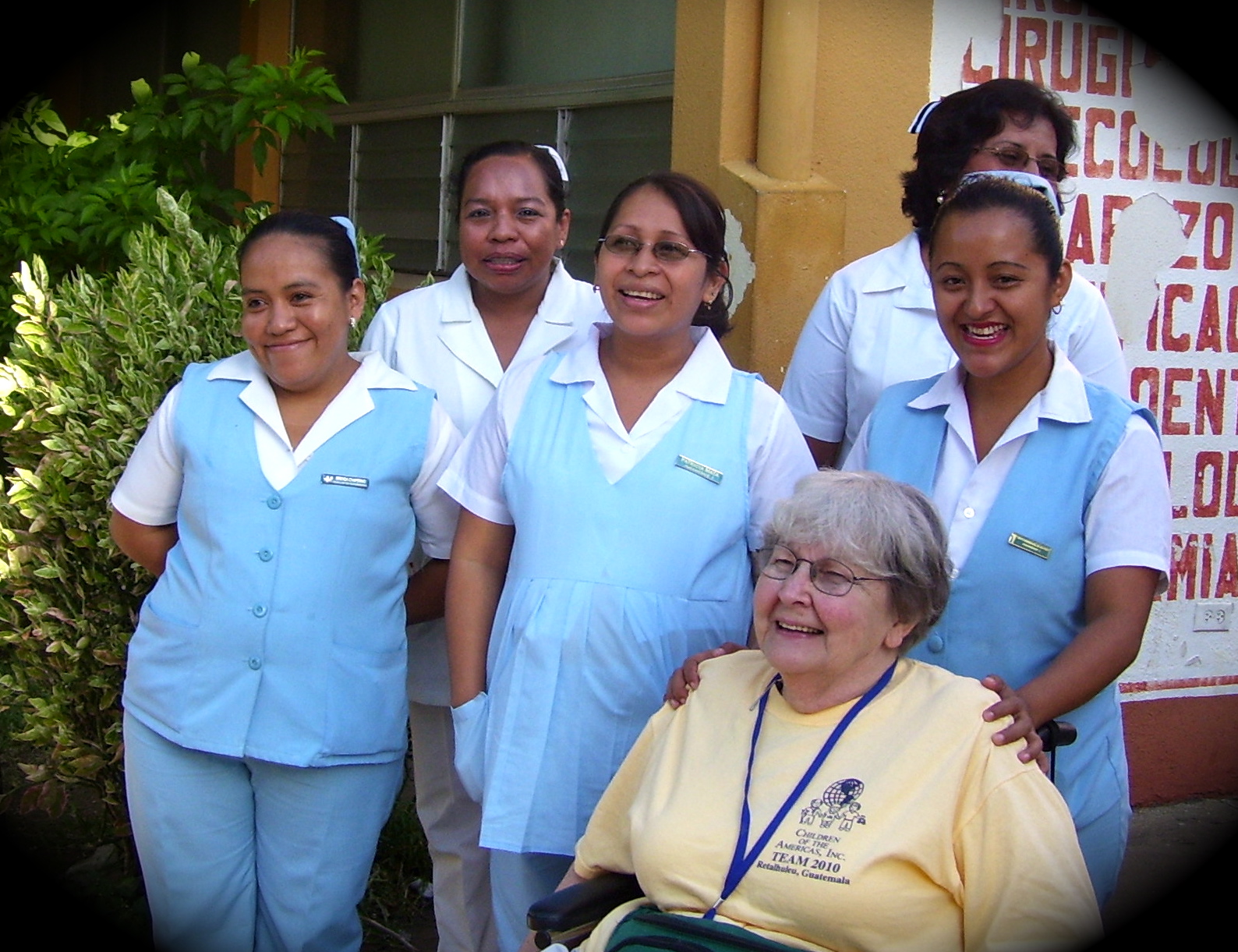 |
| Dr. Carol Cottrill, COTA Board President, with Guatemalan nurses |
Thursday, June 13, 2013
Definition of a Father
fa·ther (fä

 r)n.
r)n.
r)n.
a. A male person who contributes to the conception of a child.
b. A man who adopts a child.
c. A man who raises a child.
 |
| Warren, COTA Foster Dad |
Children of the Americas routinely touts the benefits, joys, trials and tribulations of fostering the children in our program who come to the states for medical care. It is not an easy job to enter into a long-term relationship with a sick child from Guatemala who speaks no English, is homesick, may be malnourished and will have medical care issues. Our accolades for this challenging job tend to go to the foster mothers. In honor of Father's Day, we are reversing the familiar ditty, by claiming that behind every good woman, is a great man.
 |
| Henry, COTA Foster Dad |
There is something that happens in the heart of a woman when she feels the need to foster a child. That "something" is different for each person who takes this job on.
It may be an empty nest. Or no nest. It might simply be the need to assist a Guatemalan mother who needs help for her child. The glimmer of an idea becomes a nudge that leads to a call to COTA volunteers and if the there is a need, a child finds a sanctuary in a foster home that leads to restored health.
None of this would be possible without the consent of an understanding husband who is willing to be second-best while the household revolves around the needs of a sick child.
Amazingly, 114 men have said "yes" when their wife uttered the words "Honey, we need to talk."
 |
| Mike with foster daughter |
Amazingly, 114 men have said "yes" when their wife uttered the words "Honey, we need to talk."
These men have agreed to long drives to airports, clinics, and hospitals. Our COTA foster fathers gave up timely meals, or sometimes any meal at all. They have shared disposable income, time with their wives, and days off of work. These foster fathers add sick children to family vacations, to carpools and to homework schedules. They worry, keep bedside vigil and change surgical dressings like a pro. Many of them agree to foster more than one sick child over a period of years. These men are fathers in every sense of the word. The best of the best.
 |
| Vince, with COTA Foster Child |
One of the most common misconceptions about our program is that our foster parents and board members get paid for our work. Our foster fathers do get paid, but not with money. Instead, their fortune is earned through experiencing the repair of a cleft lip, or the ability of a child's ability to walk again. These men understand that the intrinsic rewards of stepping up to meet a significant and worthwhile need are the best fortunes. In our organization, we think there should be a new dictionary definition to the word father. For COTA purposes, the definition should read as follows:
fa·ther (fär): one who agrees to take a sick child into his heart and home, only to have to return that child to the biological mother upon recovery. A man who is willing
r): one who agrees to take a sick child into his heart and home, only to have to return that child to the biological mother upon recovery. A man who is willing
to sacrifice for a child who is not his own.
Happy Father's Day to our COTA Foster Fathers.
You have made the world a better place in every sense of the word.
Wednesday, April 24, 2013
A Good Kind of Tired
 Children of the Americas surgical team members recognize the "look" (left). This volunteer's face radiates a mixture of heat exhaustion and physical fatigue during our recent medical/surgical and dental team to Retalhuleu,
Guatemala. When one gets this tired, the only thing keeping the body going is grit and determination and the kind of fortitude that makes someone sign up to volunteer for a team to Guatemala.


During quiet moments, we think of the patients that touched our hearts while we were in Guatemala. There are always those special ones that we know we were meant to be in Guatemala for; the clefts that would not have survived, the children who might not have ever walked, the women who would have struggled with unresolved surgical needs. Gratitude: for the chance to both travel with COTA and return home...very tired.

Sunday, March 24, 2013
Having a Bad Day?
 |
| Here are a few of those someones |
 |
| Traveled all night for surgery, but still cheerfully waiting |
 |
| Single Mother with no job, awaiting free medical exam |
 | |||||
Children awaiting entry into COTA Team Clinic |
Subscribe to:
Posts (Atom)
Twenty Years of COTA: Perspective and Memories from Warren Brandwine
My first COTA mission to Peten was in January, 2000. We flew up to San Benito in a surplus C-130 with the door held on with ...

-
 My first COTA mission to Peten was in January, 2000. We flew up to San Benito in a surplus C-130 with the door held on with ...
 -
 It is 2 am and I'm sitting next to a mug of hot coffee that Lauren just made- we are sharing it with the other nurses that wor...
 -
 He was humble and sweet and kind all in one bundle of a handsome young man who didn't know how attractive he really was. At age twenty-...